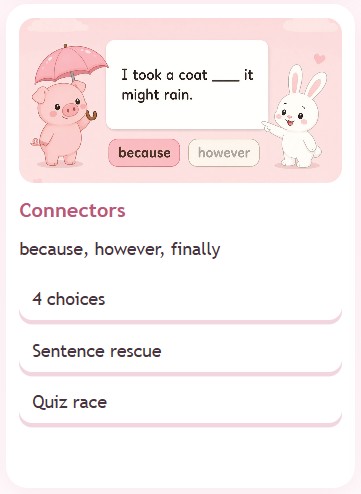
A connector joins two ideas so the reader can follow them.
Quick Tips for Primary School Students:
Use sequence connectors (first, next, then, finally) when writing stories.
Use cause and effect connectors (because, so, therefore) to explain reasons.
Use contrast connectors (but, however, although) to show different ideas.
Use the group headings to choose the job, then borrow one example and change the names. Don’t overuse the same connector. Two or three different connectors in a composition are enough.
1. Adding Information
| Connector | Meaning | Example 1 | Example 2 (Composition Style) |
| and | Connects two similar ideas | I like apples and oranges. | I enjoy reading books and playing football. |
| also | Adds another point | She is kind. She is also helpful. | The weather was hot. It was also very humid. |
| moreover | Adds a stronger point | The food was delicious. Moreover, the service was excellent. | The movie was exciting. Moreover, the acting was superb. |
| furthermore | Adds more information | He is talented. Furthermore, he is hardworking. | The park is beautiful. Furthermore, it is very clean. |
| in addition | Adds another idea | I visited the museum. In addition, I went to the zoo. | She studied hard. In addition, she revised every night. |
| besides | Adds another reason | I don’t want to go. Besides, it’s raining. | He didn’t join us. Besides, he was feeling unwell. |
2. Showing Contrast / Opposition
| Connector | Meaning | Example 1 | Example 2 (Composition Style) |
| but | Shows difference | I wanted to play, but it rained. | She tried her best, but she did not win. |
| however | Shows contrast (formal) | He is rich. However, he is not happy. | The test was difficult. However, I managed to pass. |
| although | Shows contrast | Although it was raining, we went out. | Although he was tired, he continued studying. |
| even though | Stronger form of although | Even though she was scared, she spoke up. | Even though it was late, he finished his homework. |
| nevertheless | Despite that | It was raining. Nevertheless, we continued the match. | She failed once. Nevertheless, she tried again. |
| on the other hand | Shows the opposite view | Some like cats. On the other hand, others prefer dogs. | The plan was good. On the other hand, it was too expensive. |
| yet | Shows contrast (similar to but) | He is young, yet he is very responsible. | The task was difficult, yet she completed it. |
3. Showing Cause and Effect
| Connector | Meaning | Example 1 | Example 2 (Composition Style) |
| because | Shows reason | I stayed home because I was sick. | He scored well because he studied hard. |
| so | Shows result | It was raining, so we stayed indoors. | She forgot her book, so she could not do her homework. |
| therefore | Shows conclusion (formal) | He studied hard. Therefore, he passed. | The team trained well. Therefore, they won the match. |
| as a result | Shows consequence | He didn’t study. As a result, he failed. | She exercised daily. As a result, she became healthier. |
| consequently | Shows result | It rained heavily. Consequently, the match was cancelled. | He was rude to others. Consequently, he lost many friends. |
| due to | Because of | The match was cancelled due to the rain. | She was absent due to illness. |
| since | Because | Since it was late, we went home. | Since he was kind, everyone liked him. |
4. Showing Sequence / Order (Very Useful for Stories)
| Connector | Meaning | Example 1 | Example 2 (Composition Style) |
| first / firstly | Shows the first point | First, I woke up early. | Firstly, we planned our trip. |
| next | Shows what comes after | Next, we went to the zoo. | Next, the children played games. |
| then | Shows what happens after | I ate breakfast. Then, I went to school. | She finished her homework. Then, she watched television. |
| after that | Shows the next step | We had lunch. After that, we rested. | He scored a goal. After that, his team celebrated. |
| later | Shows something happened after | We played outside. Later, it started to rain. | She studied hard. Later, she felt confident. |
| finally / lastly | Shows the last point | Finally, we reached the top of the mountain. | Lastly, I would like to thank my teacher. |
| eventually | After a long time | He kept trying and eventually succeeded. | She faced many problems but eventually overcame them. |
5. Giving Examples
| Connector | Meaning | Example 1 | Example 2 (Composition Style) |
| for example | Gives an example | I like fruits. For example, I love mangoes. | Many animals are endangered. For example, tigers and pandas. |
| for instance | Gives an example | Some students are very talented. For instance, John can play the piano well. | There are many fun activities in school. For instance, we have art and music lessons. |
| such as | Gives examples | I enjoy outdoor activities such as swimming and cycling. | She has many hobbies such as reading and drawing. |
| like | Gives examples (informal) | I like sports like football and basketball. | Animals like dogs and cats make good pets. |
6. Showing Similarity
| Connector | Meaning | Example 1 | Example 2 (Composition Style) |
| similarly | In a similar way | John is hardworking. Similarly, his sister is also diligent. | The first plan failed. Similarly, the second plan did not work. |
| likewise | In the same way | She loves reading. Likewise, her brother enjoys books. | The team played well. Likewise, the coach was happy. |
| in the same way | Similarly | He helps others. In the same way, his friend is also kind. | She faced many challenges. In the same way, her brother also struggled. |
7. Concluding / Summarizing
| Connector | Meaning | Example 1 | Example 2 (Composition Style) |
| in conclusion | To conclude | In conclusion, we should protect the environment. | In conclusion, teamwork is very important. |
| to sum up | To summarize | To sum up, the trip was enjoyable. | To sum up, the story teaches us to be kind. |
| overall | Considering everything | Overall, it was a good experience. | Overall, the project was a success. |
| in short | Briefly | In short, she is a talented student. | In short, we had a wonderful day. |
| all in all | Considering everything | All in all, it was a memorable holiday. | All in all, the event was well organized. |
Practice Time: